From Euler's Latin Squares to Tokyo's Nikoli Revolution: The 240-Year Evolution and Neuro-Logic of Sudoku
Uncover the true history of sudoku euler latin squares, tracing its path from 18th-century Swiss mathematics to modern prefrontal neuroscience.
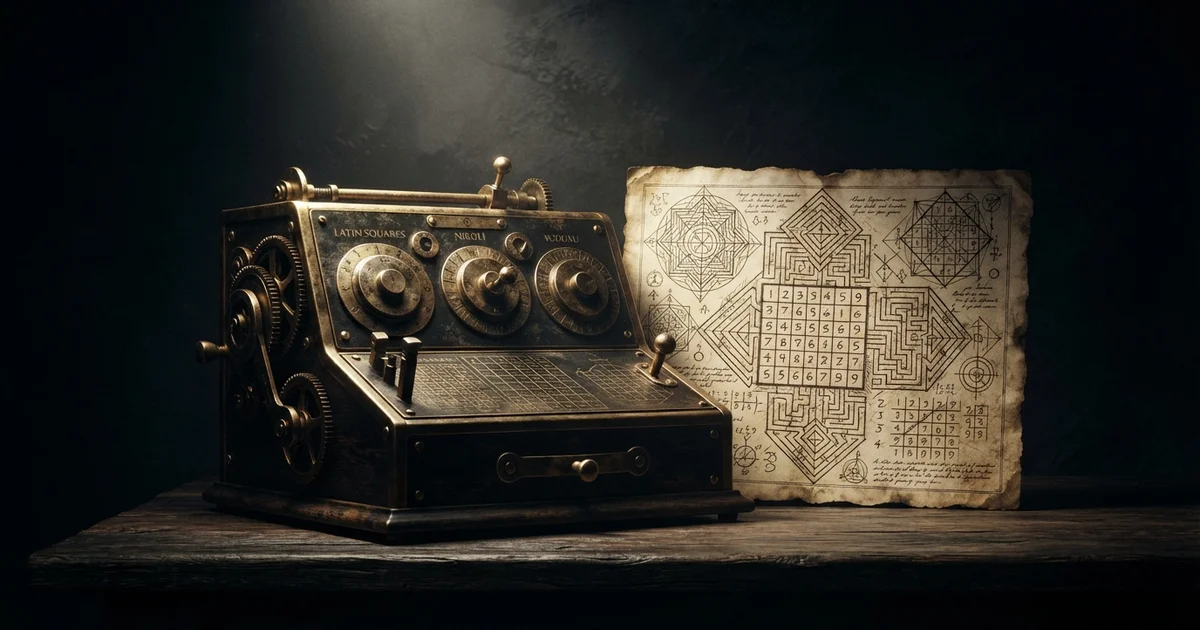
- •Sudoku did not originate in ancient Asia; its direct mathematical lineage descends from Leonhard Euler's 1783 work on Latin Squares.
- •Architect Howard Garns invented the modern 9x9 grid with 3x3 sub-boxes in 1979 under the title 'Number Place'.
- •Nikoli publisher Maki Kaji refined the format in Tokyo with strict symmetry rules and human-deducible logic, creating the global Sudoku phenomenon.
- •Solving Sudoku engages the dorsolateral prefrontal cortex, transforming abstract constraint satisfaction problems into potent working memory exercises.
A persistent myth in popular culture claims that Sudoku originated as an ancient mystical game in China or feudal Japan. Popular mythology often conflates the puzzle with the Lo Shu Magic Square or imperial calligraphy exercises. However, the rigorous history of sudoku euler latin squares reveals a completely different, mathematically fascinating origin.
The true lineage of Sudoku is not ancient eastern mysticism. Instead, it is a 240-year voyage spanning 18th-century Swiss combinatorics, a 74-year-old retired American architect in Indiana, and an eccentric Tokyo publisher whose strict aesthetic rules transformed a mechanical matrix into an international cognitive addiction.
Beyond its historical trajectory, modern neuroimaging demonstrates that Sudoku’s mathematical architecture mirrors the human brain's natural constraint satisfaction networks, engaging prefrontal working memory and spatial logic in unique ways.
Phase 1: Leonhard Euler and the Latin Square (1783)
The formal mathematical ancestry of modern Sudoku began in Basel and St. Petersburg with the prolific Swiss mathematician Leonhard Euler. In his 1782 paper Recherches sur une nouvelle espèce de quarrés magiques (Research on a new kind of magic square), published posthumously in 1783, Euler analyzed a system he termed a "Latin Square."
✦ Theorem: The top and left outer edges are guaranteed lines that wrap around the top-left vertex.
An n × n Latin Square is an arrangement of n distinct symbols such that each symbol appears exactly once in every row and exactly once in every column. Euler used Latin characters (hence the name) to distinguish them from numeric magic squares, which rely on arithmetic summation rather than combinatorial placement.
Euler expanded this inquiry into the famous "36 Officers Problem," which asked whether 36 officers drawn from 6 different regiments and holding 6 different ranks could be arranged in a 6×6 square such that no rank or regiment was repeated in any row or column. Euler correctly conjectured that no such orthogonal Latin Square exists for n = 6 (or any n = 4k + 2), a theorem finally proven by Gaston Tarry in 1901.
Euler’s Latin Squares provided the foundational grid logic for modern number puzzles. However, one structural rule was missing: the sub-box constraint.
Phase 2: Howard Garns and the Birth of "Number Place" (1979)
For nearly two centuries, Latin Squares remained a subject of discrete mathematics, theoretical cryptography, and statistical agricultural design. That changed in 1979 when Howard Garns, a 74-year-old retired architect and freelance puzzle constructor from Indianapolis, introduced a transformative structural constraint.
Garns took Euler’s 9×9 Latin Square and divided the 81 cells into nine independent 3×3 sub-grids (known today as "regions", "blocks", or "nonets"). By demanding that the digits 1 through 9 appear without repetition across three intersecting dimensions—rows, columns, and 3×3 blocks—Garns shifted the puzzle from simple Latin Square arithmetic to a multi-layered Constraint Satisfaction Problem (CSP).
Year Howard Garns published the first modern 9x9 Sudoku
Benchmark: Appearing in Dell Pencil Puzzles under the title "Number Place"
Garns published his creation anonymously under the title "Number Place" in the May 1979 issue of Dell Pencil Puzzles and Word Games. While Number Place gained a loyal following in American puzzle magazines throughout the early 1980s, it lacked one final ingredient: an editorial philosophy that turned raw combinatorial grids into elegant, human-solvable logic art.
Phase 3: The Nikoli Revolution in Tokyo (1984–1986)
In April 1984, Maki Kaji, the founder of the pioneering Japanese puzzle publisher Nikoli, discovered Number Place in an imported American magazine. Recognizing the universal appeal of a language-independent logic puzzle, Kaji introduced the format to Japan under the title Sūji wa dokushin ni kagiru ("The numbers must remain single" or "unmarried").
Kaji quickly shortened the unwieldy title to its iconic abbreviation: Sudoku (Sū = number, Doku = single).
Nikoli did not merely copy Garns' work; they refined it with two uncompromising editorial standards that transformed the game into an art form:
- Rotational Symmetry: The distribution of starting clues must exhibit 180-degree rotational symmetry across the central axis.
- Deterministic Human Solvability: Puzzles must never require guessing or trial-and-error (brute-force backtracking). Every cell must be solvable through pure deductive logic.
When New Zealand judge Wayne Gould developed a computer program in 1997 to generate unique Sudoku puzzles and convinced The Times (London) to publish them in November 2004, the puzzle triggered a global media phenomenon. Within twenty-four months, Sudoku had spread to newspapers across every continent.
| Era / Developer | Year | Structural Innovation | Mathematical & Design Rule |
|---|---|---|---|
| Leonhard Euler | 1783 | Latin Square | n × n grid; unique elements in rows and columns only |
| Howard Garns | 1979 | Number Place | 9×9 grid; added nine 3×3 regional sub-box constraints |
| Maki Kaji (Nikoli) | 1984 | Modern Sudoku | 180° visual symmetry; deterministic human-solvable logic |
| Modern Digital Era | 2005+ | Algorithmic Solvers | Exact Cover formulation; Donald Knuth's Algorithm X |
The Neuro-Logic of Sudoku: Prefrontal Constraint Satisfaction
Why does Euler and Garns' combinatorial structure engage human attention so intensely? The answer lies in cognitive neurobiology.
From a computational standpoint, Sudoku is an Exact Cover Problem belonging to the NP-complete complexity class. When human players solve a puzzle without algorithmic computers, they cannot check billions of branch permutations. Instead, the human brain executes hierarchical constraint satisfaction through specific neural networks.
1. Dorsolateral Prefrontal Cortex (dlPFC) & Working Memory
The dlPFC acts as the central executive, maintaining temporary candidate states (such as tracking potential {3, 7} pairs in row 4) within working memory. Because human working memory is constrained by Miller’s Law (7 ± 2 active informational chunks), expert solvers use structural chunking—grouping candidate numbers into visual geometric patterns like Naked Pairs, Pointing Triples, and X-Wings.
2. Posterior Parietal Cortex (PPC) & Spatial Mapping
The PPC processes the spatial grid coordinates (e.g., intersecting Row 7 with Box 9). It calculates overlapping spatial constraints, allowing the solver to isolate empty candidate cells across the 2D plane.
3. Anterior Cingulate Cortex (ACC) & Dopaminergic Reward
The ACC continuously monitors mental calculations for conflicts (e.g., identifying a duplicate 4 in a column). When a difficult multi-step deduction eliminates all competing candidates and resolves a cell, the brain experiences an "Aha!" moment. This cognitive breakthrough triggers a burst of dopamine in the nucleus accumbens, reinforcing the neural pathways involved in deductive reasoning and visual search.
The Enduring Legacy of Euler's Vision
Sudoku's journey from an 18th-century Swiss academic paper to American puzzle magazines and Japanese editorial rooms shows how pure discrete mathematics can evolve into timeless culture. What Leonhard Euler explored as an abstract inquiry into Latin Squares evolved, through the spatial design of Howard Garns and the aesthetic discipline of Nikoli, into the world's most widely practiced exercise in prefrontal logic.
Every time you place a solitary digit into a 9×9 grid, you are not engaging in ancient folklore. You are directly participating in a 240-year-old mathematical dialogue—and challenging your frontoparietal networks with one of the most elegant constraint satisfaction problems in history.
Frequently Asked Questions
Published by the Puzzle Paradise Research & Editorial Team. Every puzzle technique and guide is empirically verified, step-by-step illustrated, and crafted to build real cognitive problem-solving ability.
Related Strategy Guides & Articles
Unlock Your Brain's Full Potential: The Cognitive Science Behind Daily Puzzle Play
Explore peer-reviewed cognitive science behind daily puzzle play. Discover how crosswords, Sudoku, and logic games boost memory, executive function, and neuroplasticity.
Dual-Stream Mental Fitness: Why Hybrid Grid Puzzles Activate Both Spatial and Verbal Hemispheres
Discover how hybrid puzzles like Wordoku combine orthographic recognition with 2D spatial constraints to train verbal and spatial hemispheres simultaneously.
The Prefrontal Cortex Workout: What 15 Minutes of Daily Sudoku Actually Does to Your Working Memory
Explore how 15 minutes of daily Sudoku trains working memory, activates the prefrontal cortex, and drives measurable cognitive transfer.