Kakuro & Number Grid Mastery: Combinatorics, Unique Partitions & Block Deduction
Unlock the mathematical secrets of Kakuro (Cross Sums), Futoshiki, and KenKen using unique partition tables, parity checks, and sandwich constraints.
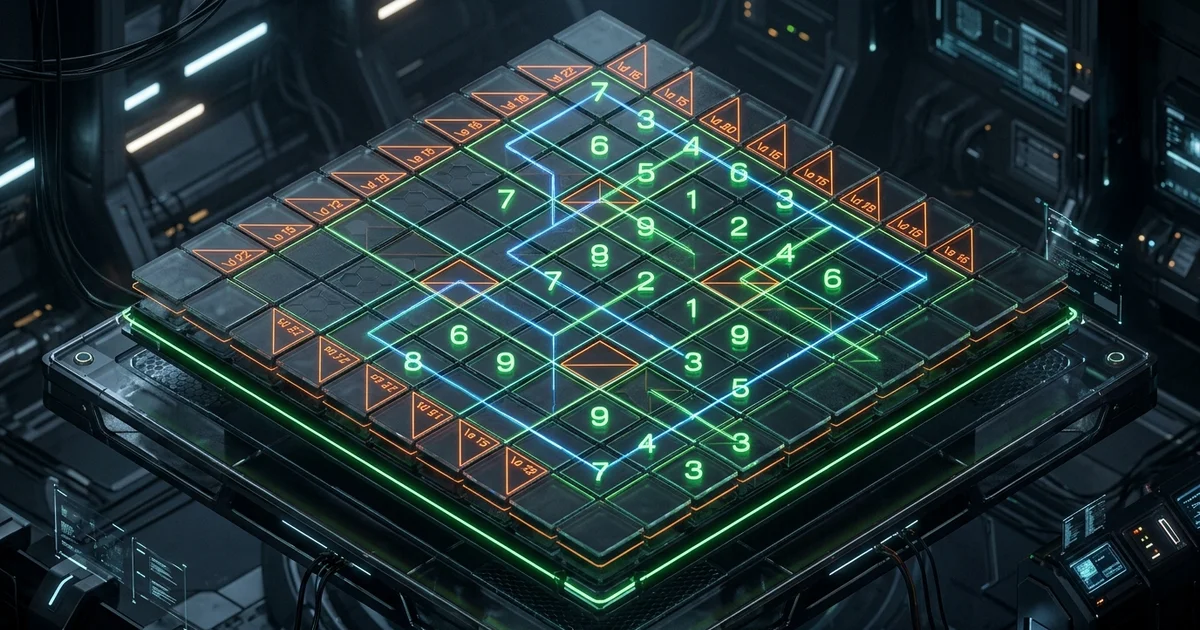
Kakuro Magic Partition Table
- 2-Cell Runs:
3 = 1 + 24 = 1 + 316 = 7 + 917 = 8 + 9- 3-Cell Runs:
6 = 1 + 2 + 37 = 1 + 2 + 423 = 6 + 8 + 924 = 7 + 8 + 9- 4-Cell Runs:
10 = 1 + 2 + 3 + 429 = 5 + 7 + 8 + 930 = 6 + 7 + 8 + 9
1. The Power of Unique Integer Partitions
In Kakuro, many clues have only one valid combination of digits, regardless of order. Memorizing these key partitions gives tournament solvers a tremendous speed advantage:
| Run Length | Clue Sum | Unique Digit Combination |
|---|---|---|
| 2 Cells | 3 | {1, 2} |
| 2 Cells | 4 | {1, 3} |
| 2 Cells | 16 | {7, 9} |
| 2 Cells | 17 | {8, 9} |
| 3 Cells | 6 | {1, 2, 3} |
| 3 Cells | 7 | {1, 2, 4} |
| 3 Cells | 23 | {6, 8, 9} |
| 3 Cells | 24 | {7, 8, 9} |
| 4 Cells | 10 | {1, 2, 3, 4} |
| 4 Cells | 30 | {6, 7, 8, 9} |
When you see a 3 and an 8 perpendicular to each other, you can cross-eliminate candidates instantly!
2. Cross-Sum Intersect Analysis
Consider a simple cross-intersection:
- Horizontal Clue (2 cells): Sum =
4→{1, 3} - Vertical Clue (2 cells): Sum =
16→{7, 9}
Because the intersection cell must satisfy both clues simultaneously, what happens if the vertical clue was instead Sum = 10 with digits {1, 9}? The intersecting cell must be 1, because 1 is the only number shared between {1, 3} and {1, 9}.
Since 4 only uses {1, 3} and 10 requires {1, 9}, the intersection cell is uniquely forced to 1.
3. Extending Logic to Futoshiki & KenKen
The same numeric elimination principles apply across the entire logic grid family:
- Futoshiki Inequality Chains (/futoshiki):
- In a 5x5 grid, a chain like
A > B > C > DforcesA=5, B=4, C=3, D=2orA=4, B=3, C=2, D=1. The highest value must sit at the root of the chain.
- In a 5x5 grid, a chain like
- KenKen / Calcudoku (/kenken):
- Multiplicative cages (e.g.,
24×in 3 cells) break down into prime factorization (24 = 2 × 2 × 2 × 3 = 1 × 4 × 6or2 × 3 × 4).
- Multiplicative cages (e.g.,
4. Play the Number Logic Suite on Puzzle Paradise
- Solve daily arithmetic cross sums in Kakuro.
- Master inequality grids in Futoshiki.
- Test arithmetic operations in KenKen / Calcudoku.
- Build your number intuition with Classic Sudoku and Hidato Pathfinding.
- Check your ranking among worldwide solvers on the Leaderboard.
Frequently Asked Questions
Published by the Puzzle Paradise Research & Editorial Team. Every puzzle technique and guide is empirically verified, step-by-step illustrated, and crafted to build real cognitive problem-solving ability.
Related Strategy Guides & Articles
The Geometry of Deduction: Solving Multivariable Logic Grids with Matrix Algebra
Master multivariable logic grids by eliminating cognitive overload with linear algebra, cross-elimination heuristics, and structured binary matrices.
The 4% Challenge Rule: Calibrating Slitherlink Difficulty Loops to Trigger Effortless Cognitive Flow
Master the 4% challenge heuristic in Slitherlink. Calibrate grid complexity to eliminate cognitive fatigue and sustain peak flow state.
From Euler's Latin Squares to Tokyo's Nikoli Revolution: The 240-Year Evolution and Neuro-Logic of Sudoku
Uncover the true history of sudoku euler latin squares, tracing its path from 18th-century Swiss mathematics to modern prefrontal neuroscience.